The Story of John Conrad, Co. G 105th Regiment, Pennsylvania Volunteers with Pension File Download
John Conrad (1833–1915)
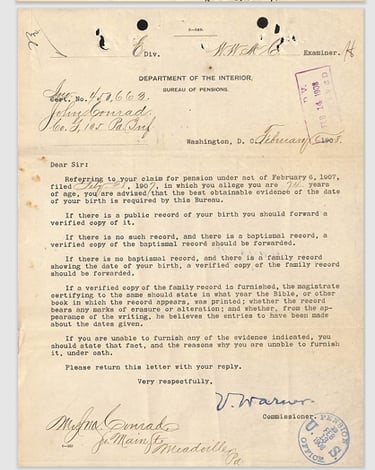
John Conrad was born on April 1, 1833, in Pennsylvania, though military records later listed his birth date as June 11, 1838. He was the son of Christopher Conrad and would go on to build a large family with his wife, Mary Ross.
Together, John and Mary raised nine children: Sarah Ann, James, Louisa Minerva, Nancy, Gertrude (Gilles), Delilah (Keim), Charlotte (DeVillers), Lucy (Lemcer), and William Conrad. Their lives, like many families of the time, were shaped by both growth and hardship—including the tragic deaths of daughters Nancy and Louisa in 1876, a story preserved elsewhere in this collection.
Civil War Service
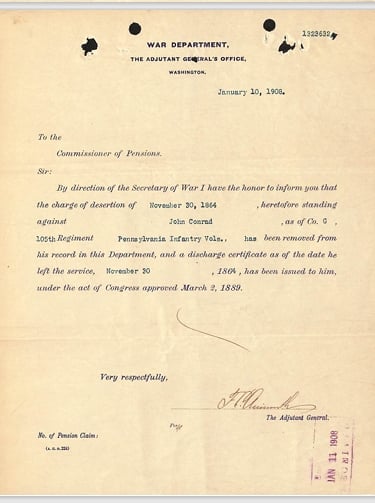
John Conrad was drafted into the Union Army on August 19, 1863, during the height of the Civil War. His military record, like many of the era, is not without contradiction.
Early pension records alleged that he deserted on November 30, 1864, and was not honorably discharged. These same records also denied his pension claim on the basis that he failed to demonstrate a qualifying level of disability.
However, later documentation provides a clearer and more complete account.
Records show that John was present for duty in July and August of 1864, before falling ill. On August 3, 1864, he was admitted to Stanton General Hospital in Washington, D.C. His condition required continued care, and he was transferred multiple times:
September 1, 1864 – U.S.A. General Hospital, Philadelphia
September 6, 1864 – Turner’s Lane Hospital, Philadelphia
September 26, 1864 – Convalescent Camp, Washington, D.C.
He was furloughed on October 26, 1864, and formally discharged on October 30, 1864.
These records suggest not desertion, but illness—an important distinction, and one not always clearly reflected in early pension decisions.
Health and Later Life
The long-term effects of his illness followed John Conrad well beyond the war.
A physical examination conducted on January 22, 1884, recorded him as 5 feet 8½ inches tall and weighing 132 pounds. Medical notes describe a furred tongue, chronic gastrointestinal distress dating back to 1865, and persistent pain. He reported ongoing diarrhea, requiring medication to maintain regular bowel function, along with discomfort in his lower back.
Examiners noted no evidence of “vicious habits” and described him as sober and of sound mind. His disability was rated at one-fourth.
These details, though clinical, offer a quiet glimpse into the lasting toll of his service—conditions endured not on the battlefield alone, but in the decades that followed.
Final Years
John Conrad died on November 25, 1915, in Meadville, Crawford, Pennsylvania.
He was laid to rest at Greendale Cemetery, buried alongside his wife Mary in Section C, Lot 47.
A Quiet Presence in the Record
John Conrad’s story is not one of dramatic headlines, but of persistence. His life is pieced together through records—military files, medical examinations, census entries—and through the lives of the children he raised.
If his presence has seemed quieter than others in the family, it is perhaps because his story was carried in fragments rather than told outright. Yet those fragments, when gathered, reveal a man who served, endured illness, raised a large family, and lived into his eighties.
And sometimes, in family history, that quiet endurance speaks just as loudly as anything else.