This family history story recounts the tragic deaths of Nancy and Louisa Conrad
in 1876 Pennsylvania and the disturbing events that followed.
Sisters Nancy and
Louisa Minerva Conrad
Family Background and Lineage
Nancy Conrad
BORN about 1866 • Pennsylvania
Died FEB 8, 1876 • East Fairfield, Crawford, Pennsylvania
FindAGrave Memorial ID 269261381
Louisa Minerva Conrad
BORN about 1862 • Pennsylvania
Died FEB 8,1876 • East Fairfield, Crawford, Pennsylvania
FindAGrave Memorial ID 269261369
Parents – John Conrad and Mary Ross
Other Siblings:
Sarah Ann Conrad (1857–1947)
James Conrad (1859–1915)
Gertrude Conrad (1869–1950)
Delilah K Conrad "Keim" (1871–1919)
Charlotte Conrad "DeVillors" (1872–1952)
Elnora Bell Conrad 'Dean' (1877–1962)
Lucy Conrad (1879–1915)
William conrad (_–1915)
The Quilt of Family Memory
Families are like patchwork quilts, each square representing a unique story, stitched together by time and memory. Some squares glow with warmth and joy, while others are frayed and somber, woven from darker threads. Yet even those darker patches are vital to the tapestry, contributing to the depth and complexity of our shared history.
This story emerges from one of those darker patches—a tale of tragedy and resilience that cast a long shadow over one branch of our family tree.
Why This Story Matters
Why share it? Because every story matters. Every name, every life, every event—whether joyful or heartbreaking—adds texture to who we are today. By honoring even the painful chapters of our past, we give voice to those who came before us and recognize the strength it took to build the family we know now.
How This Story Connects to Our McGill Line
The mother in this story, Mary (née Ross) Conrad, was the sister of Charlotte (née Ross) McGill, grandmother to our beloved “Gram.” I’ve pieced together this narrative from newspaper articles, census records, and cemetery reports.
Choosing a Narrative Perspective
When I first learned this unthinkable story, my heart broke for the younger sister, Gertrude Conrad, who lived through it. With her in mind, I’ve chosen to imagine and recount these events from her perspective. So, settle in as we journey into the past, searching for glimmers of humanity and hope amid the shadows.
Frozen Shadows –
The Story of Nancy and Louisa Conrad
A Winter Day at Irvin’s Pond
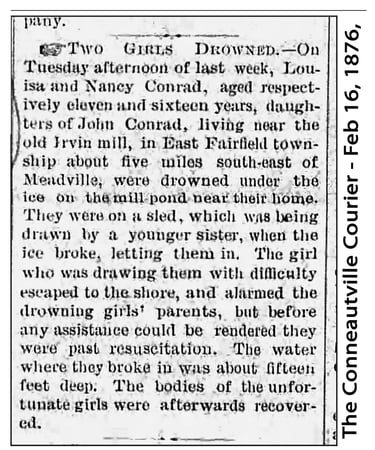
The winter of 1876 in East Fairfield, Pennsylvania, was a cruel one, blanketing the landscape in an unyielding chill that seemed to freeze not just the earth but the soul. Irvin’s Pond, a small, seemingly unremarkable body of water five miles south of Meadville, lay under a treacherous sheet of ice.
Gertrude’s Childhood Memory
That day is etched into my memory, no matter how much I’ve tried to forget it. My name is Gertrude Conrad, and I was only eight years old. Ours was a bustling family of seven children. The older ones, Sarah—nineteen—and James—seventeen—were already working and too busy to join us. Then there were the middle three: Louisa, sixteen; Nancy, eleven; and me, the baby of the group. The youngest, Delilah, four, and Sharlat, three, were still at home with Mama, likely playing under her watchful eye while she worked.
It must have been Louisa or Nancy who suggested taking the sled to Irvin’s Pond. I pulled the sled through the biting air, my breath visible in little puffs. Behind me, Louisa and Nancy laughed, their voices brimming with a joy that felt invincible. The ice gleamed in the weak sunlight, a silvery promise of fun. Being the littlest, my job was to pull the sled, and I was happy to be part of their world.
The Ice Gives Way
The first crack was soft, like a whisper. I stopped and turned to look back at my sisters. Then came the groan of the ice, louder this time, followed by the shattering. Before I could scream a warning, they were gone—swallowed by the dark, frigid water.
A Desperate Rescue
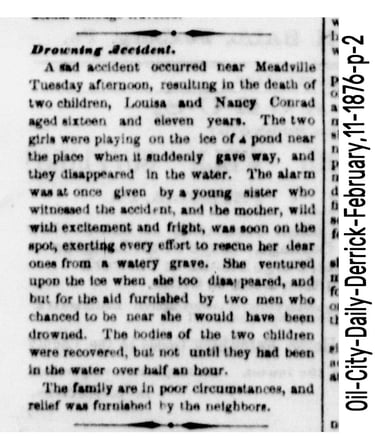
I screamed until my throat burned, though I don’t remember running. Somehow, I found myself on the bank, shouting for help. Mama heard my cries and rushed onto the ice, her desperation propelling her forward. The surface betrayed her, and she plunged into the freezing water.
Two men traveling along the road heard the commotion and ran to help. They managed to pull Mama out, her anguished cries piercing the air. It was another thirty minutes before Louisa and Nancy were retrieved. By then, their faces were pale and lifeless. I knew they wouldn’t be coming home.
Grief and Life After Loss
The days that followed were a blur of grief. They were buried in Kiser Hill Cemetery, their grave marked by a simple stone. For the first time, I saw Pa cry. Mama seemed to shrink into herself, but life on the farm didn’t pause. There were still five of us who needed her. Over the years, two more babies, Nora Bell and Lucy, were born, bringing new life to a home cloaked in sorrow.
A Second Tragedy — The Grave Robbing
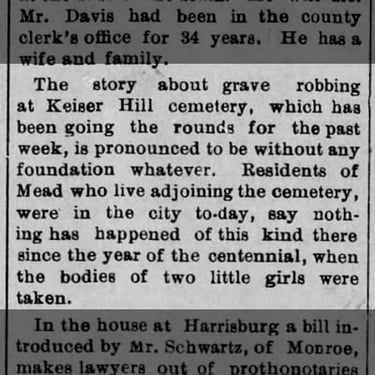
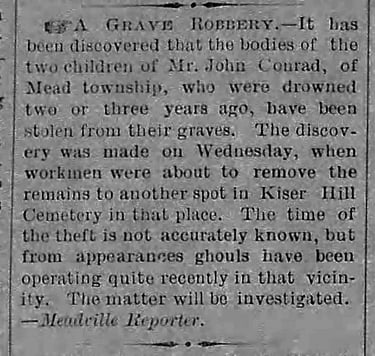
Two years later, just as we began to find a fragile sense of peace, it was shattered again. Workmen at Kiser Hill Cemetery discovered that the graves of Louisa and Nancy had been disturbed. Their bodies were gone—stolen by grave robbers.
Body Snatching in the 1870s
The news hit us like another death. Rumors swirled—ghouls, dark rituals, unspeakable horrors—but the truth was no less disturbing. Grave robbers from Cleveland had been caught. They had exhumed bodies, packed them into steamer trunks, and shipped them to Cleveland, where medical students dissected them in the name of science. Louisa and Nancy were among the stolen. Their bodies were never recovered.
Lasting Impact on the Conrad Family
The newspapers warned of "body-snatching season," urging families to guard their loved ones' graves. Though officials later claimed no other graves had been robbed at Kiser Hill since my sisters’, no one in our family was ever buried there again. The violation of their “final resting place” left scars that rippled through generations, casting a shadow over their memory.
We’ve been haunted by the loss of Louisa and Nancy, taken first by the cruelty of nature and then by the greed of men. Yet, even in this darkness, their story is part of our family’s quilt, a somber thread that speaks of loss, resilience, and the unyielding love of those left behind.
Some of the sources and records consulted in our research
1870 Federal Census • East Fairfield, Crawford, Pennsylvania
Conrad family. John Conrad 36 a farm laborer; Mary 35 keeping house; Sarah Ann 13 domestic servant; James 10; Louisa (Minerva?) 8 at home; Nancy 4 at home.