
WILLIAM JOHNSTON MCGILL, By Kerri Fawcett
Birth JULY 20 1834 • Woodcock, Crawford, Pennsylvania, USA
Death 27 JANUARY 1902 • Bayonne, Hudson, New Jersey
Son of Juliana Cochran and William Perry McGill.
Husband of Charlotte Ross McGill.
Served in the Civil War, Co F 38th Pa as a Cpl. Wounded at the Battle of Dranesville, PA
Digital Civil War Pension File is possession of Kerri Corby Fawcett.
WILLIAM JOHNSTON MCGILL, By Kerri Fawcett.
On this day in 1834, in Woodcock Township, Crawford County, Pennsylvania, our ancestor, William Johnston McGill was born. His parents were William Perry McGill and Juliana Cochran. He was the first son after four daughters and was 13 years old when his father died. He grew up on the family farm and was listed as a boatman in the 1860 census. The Civil War started and William and his brother John Patrick McGill both signed up for the Union Army. On May 11, 1861, William joined Company F of the 9th Pennsylvania Reserves in Meadville while John joined Company B of the 83rd Pennsylvania Infantry on August 15, 1861.
William and his regiment were sent to fight at Dranesville, Virginia where he was wounded by a musket-ball entering the left side of his abdomen on December 20, 1861. He was taken to the Halls Hill field hospital to be operated on and they found that damage was done to the internal wall of his abdomen and, thankfully, he was able to heal but he suffered with severe bowel and constipation problems for the rest of his life.
His brother John and his regiment were fighting in Virginia in June of 1862 when John got sick with malaria. He was taken to the field hospital and sadly died on the 25th. William was alerted that his brother had died and was given leave so he was able to go to him and then escort his body back to their home town and family for burial.
William returned to his regiment and stayed with them until he was honorably discharged after three years of service on May 11, 1864. The 9th were involved in several battles during those three years and we can only assume that William was involved in them as well after he returned to service. Here is a link to the website that will tell you more about the movements of the regiment: [9th Pennsylvania Reserves in the American Civil War](https://civilwarintheeast.com/.../9th-pennsylvania-reserves/)
After the war, William returned home to Crawford County where he soon married Charlotte Ross on November 23, 1866 at the home of Samuel Beers in Sugar Lake, Wayne Township, Crawford County, Pennsylvania. William and Charlotte went on to have nine children, five daughters and four sons. Their second child was our ancestor, Anna Tina McGill.
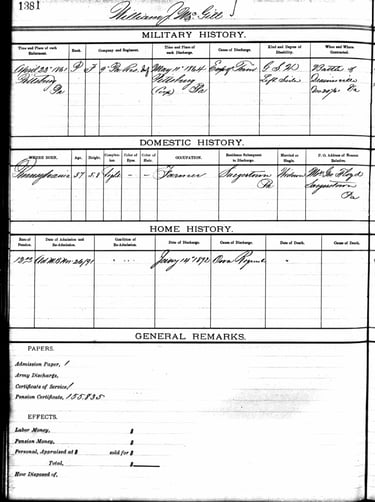
Due to his wound and the trouble that it caused William, he was entitled to a Civil War pension. (I ordered his pension file over 20 years ago and it is under the album section on this website). We find quite a lot of information about William from this file including a description of him when he was 42 years old in 1877. He was 5 feet 8 inches tall, 135 pounds with a light complexion, dark hair and gray eyes. We also have his medical records describing all of the problems he had with his bowels (probably more than we need to know!) and a personal account, in his own words, of the Battle of Dranesville and how the aftermath effected him. (I will attach that page below)
The family moved around a bit, living in various locations in Butler and Venango counties in Pennsylvania before moving to Bayonne, New Jersey in 1881 where he worked for the Standard Oil Company. Ten years later they were living on Denny Road, between 9th and 10th street when Charlotte died on July 18, 1891. She was only 45 years old. William was in poor health and could not raise his four youngest children that were still in the house so he brought them back to Crawford County to be raised by 'his people'.
William spent the last ten years of his life going back and forth between Bayonne and Crawford County. He also had some respite care at the New Jersey Home for Disabled Soldiers in Kearny, New Jersey. He was living here when the 1895 and 1900 censuses were taken. William was living at 43 1/2 West 21st Street in Bayonne when he died at the age of 67 on January 28, 1902. His cause of death was consumption of his lungs and bowels. His body was sent back home to Crawford County where he was buried in Saegertown Cemetery in section 3, lot 41. After serving his country and being wounded in battle, suffering for the last forty years of his life, I hope he finally found peace.
William Johnston McGill (1834–1902)


click to open photos to full screen preview

A Note on Historical Events:
The stories and events shared here are part of our family’s history and the wider world’s past. They are told to remember and understand—not to celebrate or encourage conflict in today’s world.
American Civil War Veteran Pension PDF Files are available thanks to Kerri Fawcett.
These Civil War pension records were obtained from the U.S. National Archives and are public domain government documents. They are shared here freely for historical and genealogical research.
On July 20, 1834, in Woodcock, Crawford County, Pennsylvania, William Johnston McGill came into this world—born to William Perry McGill and Julia Ann Cochran. One imagines him cradled in strong, hopeful arms, his parents whispering the quiet dreams all parents carry for their children.
By the age of 24, William was described as a young man of fair complexion, with dark hair and steady gray eyes—features that would soon face the trials of a nation divided.
When the War of the Rebellion called, William answered. He enlisted as a Union soldier in Company F of the 9th Regiment, Pennsylvania Reserves (38th Pennsylvania Infantry). Like so many of his generation, he stepped forward not knowing how deeply the war would follow him for the rest of his life.
On the morning of December 20, 1861, William’s fate was forever altered at the Battle of Dranesville, Virginia.
Union Brigadier General E.O.C. Ord advanced west along the Georgetown Pike with a brigade of Pennsylvania Reserves, tasked with clearing Confederate scouts and pickets from the Alexandria and Leesburg Turnpike. Around noon, the Union forces encountered the enemy near the intersection of the roads, and a two-hour firefight broke out.
Though small in scale and of little strategic importance, the battle carried meaning—it marked one of the first occasions in the eastern theater where Union forces successfully drove Confederate troops from the field.
The cost, however, was real.
The regiment lost two enlisted men and two captains. Eighteen enlisted men were wounded.
One of them was William Johnston McGill.
A musket ball struck him in the abdomen, penetrating deep into his body. Regimental Surgeon Dr. Phillips tended to him, fearing the worst. Yet by what must have felt like providence to those watching over him, the bowels were not pierced.
William survived—but he did not escape unchanged.
The months that followed were spent in camp hospitals, where recovery proved slow and incomplete. The wound left lasting internal damage, and from that time forward he suffered chronic and painful constipation—a condition that would shadow him for the rest of his life. Even the strongest medicines offered only fleeting relief.
Still, he endured.
William completed three years of service and was honorably discharged on May 11, 1864—a survivor not only of battle, but of the long suffering that followed it.
In the quieter days after the war, life began again.
In late November of 1865, William married Charlotte Ross. Their union was one of warmth and devotion, recognized and cherished by those around them. Together they built a family of nine children: Margaret Gertrude, Annie Tina, Emma Jane, Charles, Julia, Rose, William Jr., Edward Everett, and Alfred Raymond.
Following his discharge, William first ventured into the Oil Creek region of Pennsylvania, drawn by opportunity in the growing oil industry. In time, he and Charlotte made their way to Bayonne, New Jersey, where William found work as a boss trimmer for Standard Oil—overseeing the care of the company’s horses, steady work that helped support his growing family.
In 1878, William was granted a modest pension of $2 per month in recognition of his wartime injury. Yet no payment could truly account for what he carried. The wound that had spared his life continued to bind it in pain. For more than thirty years, his body endured the consequences of that December day—each year a quiet testament to survival.
And still—he carried on. For family. For duty. For the life he had fought to keep.
Tragedy returned on July 18, 1891, when Charlotte, only 45 years old, died of tuberculosis. Her loss left a silence no words could fill.
In the wake of her passing, William made a difficult and deeply human decision. Gathering his four youngest children, he returned to Crawford County, Pennsylvania—placing them “among his people,” where family ties might offer stability and comfort in the face of loss.
For a short time, William stayed at the Soldiers’ Home in Kearny, New Jersey. Eventually, he returned to Bayonne, where he lived with his sister Nancy.
By then, the long toll of his wound had fully taken hold. His body, worn by decades of pain, could no longer sustain labor. The injury that had once spared his life now slowly claimed his strength.
On January 27, 1902, William Johnston McGill passed from this world.
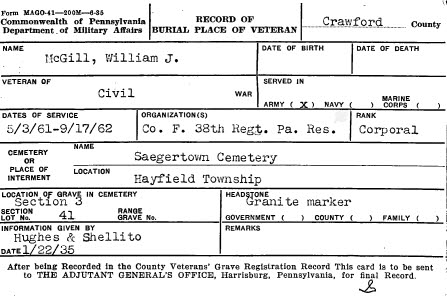
He was laid to rest in Saegertown Cemetery, Hayfield Township, Pennsylvania—Section 3, Lot 41—his Veterans Burial Certificate marking the place where his long journey came to its end.
He was 67 years old.
A soldier.
A husband.
A father.
A man who carried the war within him long after the guns had fallen silent.
And perhaps, if we listen closely, his story reminds us of something more—that survival is not always the absence of suffering, but the quiet, enduring strength to continue in spite of it.