Long before records were neatly typed and stored away in distant archives, our family history lived in ink, memory, and devotion. Much of what we know about Patrick McGill comes to us through the words of his grandson, Augustus McGill—a man who did not merely record names and dates, but preserved the spirit of those who came before him.
Augustus wrote with admiration, and at times with a storyteller’s flourish, as was often the way of his generation. In his telling, facts and feelings walk hand in hand. Through him, we see not only what Patrick McGill did, but who he was—how he was regarded, how he lived, and how deeply he was loved.
What follows is their story, carried across time by a grandson determined that it should never be forgotten.
On the windswept shores of Belfast Bay, near Carrickfergus in County Antrim, Ireland, Patrick McGill was born into a large Scotch-Irish family—one of ten children of Roland McGill and Margaret Dillon. It was a household shaped by faith, discipline, and learning. Their father, a devout Presbyterian, led daily worship and ensured each child was baptized and educated under the careful instruction of ministers who served as both pastors and teachers—a common and respected practice of the time.
Among so many sons, it was customary for one to be chosen for advancement through education. Patrick, the youngest, quiet and studious, was selected. Frailer in build but strong in mind, he was given opportunities beyond his brothers, with the hope that he might rise into the learned professions and bring honor to the McGill name.
But history intervened.
In Ulster, the path for Presbyterians was sharply limited. Laws and restrictions barred them from universities, professions, and public life unless they conformed to the established Anglican Church. Patrick would not. His convictions held firm, and rather than abandon his faith, he chose exile.
America—particularly Pennsylvania, known for its religious tolerance—became his destination.
His parents, though heartbroken, would not send him alone. His older brother Arthur—strong, capable, and deeply devoted—stepped forward and declared he would go with him. Together, the brothers left Ireland, sailing not as desperate emigrants but aboard their brother Henry’s vessel, the Good Intent, arriving safely in Baltimore.
Building a Life in a New World
From the moment they set foot in America, Patrick and Arthur proved themselves equal to the challenges ahead. Well-educated, self-reliant, and determined, they entered the booming transport trade that carried settlers westward from Philadelphia into the Pennsylvania frontier.
Arthur, energetic and bold, handled the physical demands—horses, wagons, and the road—while Patrick managed logistics with care and precision. Together, they built a thriving enterprise, moving people and goods across expanding settlements.
Their timing placed them squarely in the unfolding American Revolution.
Though not enlisted soldiers, the McGill brothers played a vital role as civilian contractors, transporting supplies, munitions, and provisions for the Continental Army. They followed the army through some of its darkest and most defining moments—marching with General Washington’s forces through Brandywine, the retreat across New Jersey, the crossing of the Raritan, and the brutal winter at Valley Forge. Like many unsung contributors, their work kept the army moving and fed, a quiet but essential service to the cause of independence.
Pioneers of the French Creek Valley
After the war, the brothers turned westward again—this time not as transporters, but as settlers.
By the early 1790s, Patrick and Arthur were among the first to establish themselves in the wilderness of northwestern Pennsylvania, along the banks of French Creek. (Arcadia Publishing) This region, rich in natural beauty and resources, was still largely undeveloped, part of the vast frontier that would become Crawford County.
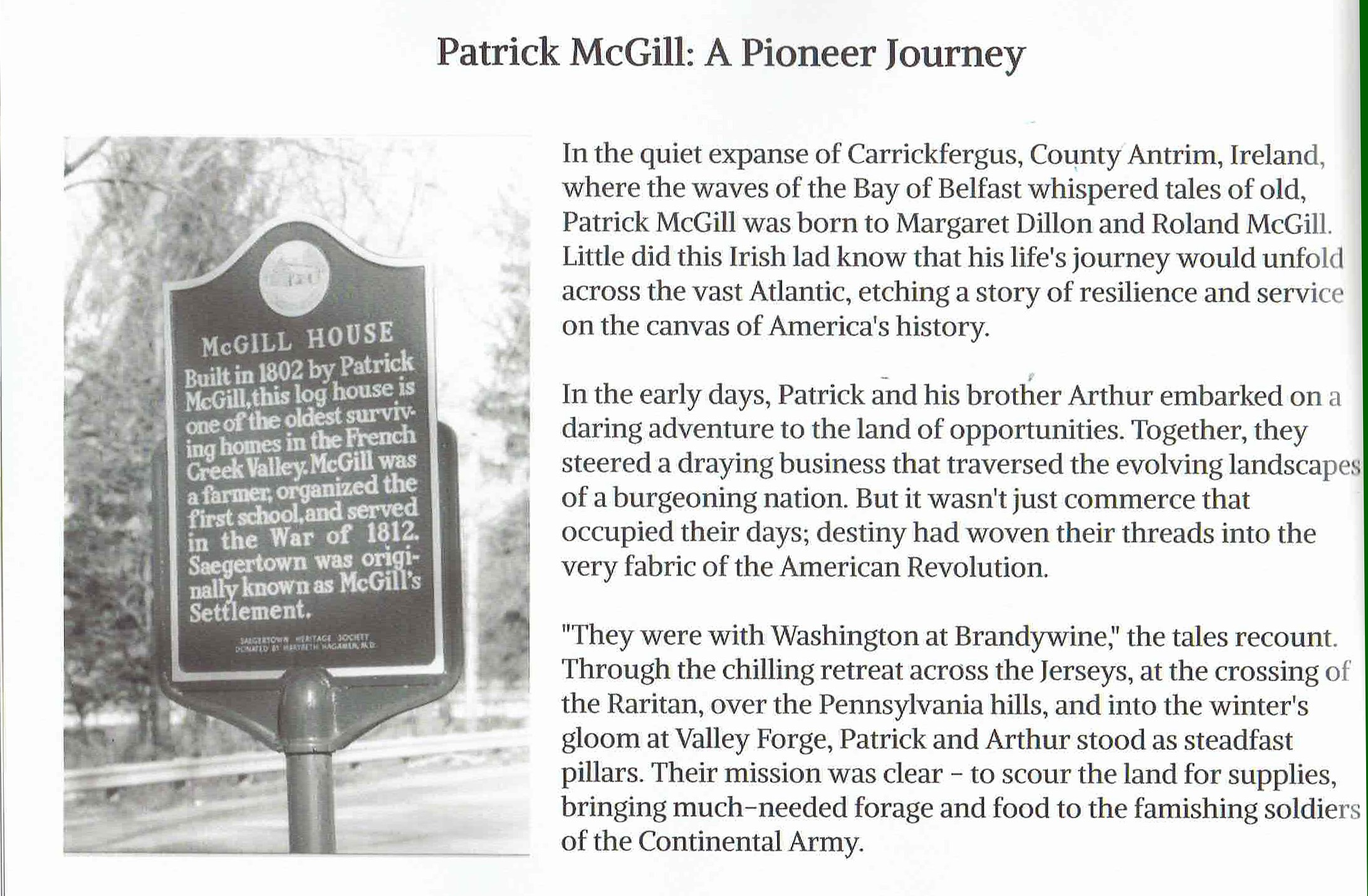
They claimed large tracts of land—hundreds of acres each—and began the hard work of transforming forest into settlement. The place that would one day be known as Saegertown was originally called McGill’s Settlement, in honor of these early pioneers.
Patrick built a log home around 1802, a structure that remarkably still stands today as one of the oldest surviving houses in the region. (French Creek Valley Conservancy) From this homestead, he farmed the land, raised his family, and became a central figure in the growing community.
He organized the area’s first school, helping ensure that the next generation would have the same foundation of learning he once enjoyed. (French Creek Valley Conservancy)
Family, Faith, and Frontier Life
Patrick married Anna Maria Baird, a woman of strong Scotch-Irish heritage—resolute, capable, and deeply devoted to her family. Together they raised three sons and two daughters.
Life in the French Creek Valley demanded endurance. Forests had to be cleared, fields planted, homes built, and roads carved through wilderness. Yet the McGill home became known as a place of hospitality. Travelers—especially fellow Ulstermen—were welcomed, fed, and sheltered as they passed through in search of land and opportunity.
Patrick never abandoned the faith of his upbringing. Like his father before him, he maintained family worship and adhered to the Calvinist principles of the Presbyterian church throughout his life.
In the War of 1812, once again Patrick answered the call when his adopted country was threatened. The McGill family’s service in the War of 1812 built upon their earlier Revolutionary War support, with the younger generation laboring to supply Perry’s fleet at Erie, while Patrick himself—no longer just a provider of aid—took up arms and marched to the front, ready at last to stand as a soldier.
A Life’s Work and a Last Farewell
By the early 19th century, the McGill brothers had done what few men accomplish—they helped carve civilization out of wilderness. They arrived before counties were formed, before towns were named, before roads were cut. (Electric Scotland) They were not just settlers—they were founders.
In February of 1832, word reached Patrick that his brother Arthur lay gravely ill. Though aged and weak himself, Patrick insisted on making the journey—just two-thirds of a mile—to see him one last time.
What passed between them in that final private meeting was never known.
Patrick returned home, laid down as if to rest, and quietly passed away on February 11, 1832. Within days, Arthur followed him.
Two brothers—who had crossed an ocean together, built a life side by side, and never parted in spirit—left this world almost hand in hand.
Legacy
Patrick McGill was remembered as a man of steadfast faith, quiet strength, and practical wisdom—a Presbyterian in belief and a Democrat in politics. He helped build not only roads and homes, but a community rooted in education, hospitality, and perseverance.
At his burial, mourners gathered from near and far—many fellow Ulstermen—honoring him with tears, and with symbols of their shared heritage: the thistle and the shamrock.
The valley they settled, once wilderness, still bears the marks of their labor.
And the old log house still stands—silent witness to a life that bridged continents, wars, and generations.
And so the story of Patrick McGill comes down to us not only through land records and dates carved in stone, but through the careful remembrance of a grandson who refused to let time wear away the edges of a life well lived. Through Augustus McGill, we are given more than history—we are given memory, colored with admiration and carried forward with purpose.
Perhaps every detail is not as plain as ink on parchment, and perhaps some moments have been softened or brightened by the telling. But in that, there is a truth of its own. For what is family history, if not the echo of how one generation was cherished by the next?
Patrick McGill’s life—marked by faith, resolve, and quiet endurance—left its imprint not only on the land he settled, but on the hearts of those who followed. And in the end, it is that remembrance, faithfully handed down, that ensures his story still stands… as steady and enduring as the old homestead raised in the valley he helped to claim.
Patrick McGill: From Belfast Bay to the American Frontier