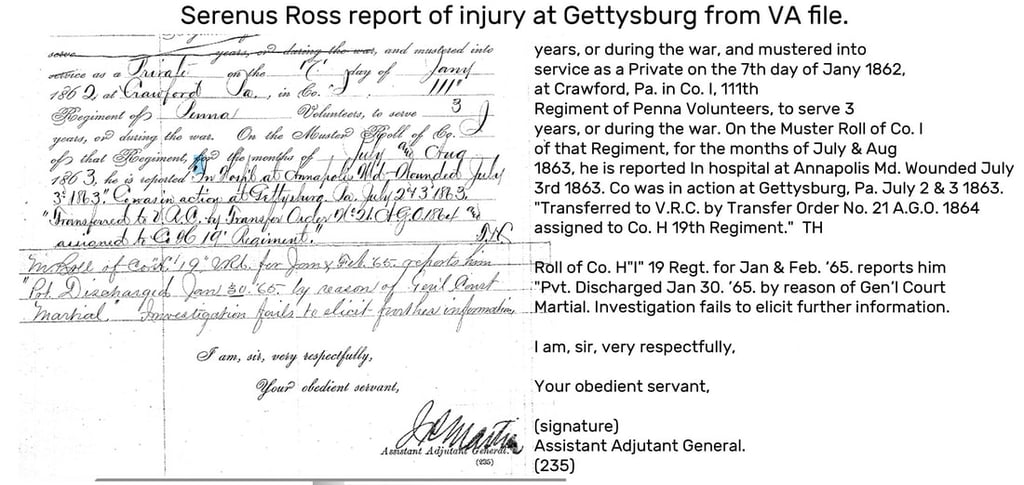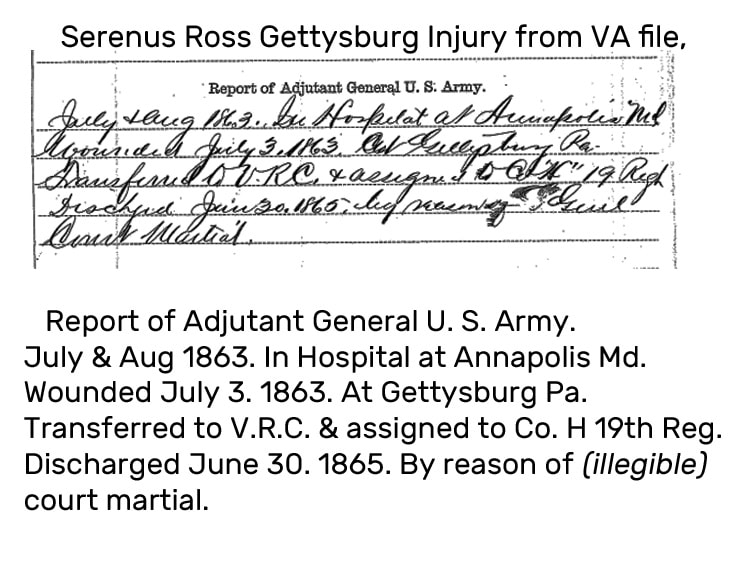
Civil War Pension File download and bio Serenus Ross, 111th Pennsylvania Infantry.
Serenus Ross was born in 1837 to William M. Ross and Hester Wirt Ross, joining a bustling Pennsylvania family that would ultimately send three of its sons to fight for the Union, along with their son-in-law, William Johnston McGill. He grew up surrounded by his siblings—Miller, William, Mary, Matilda, Delila, Gilmon, Orlando, and our Charlotte Ross, who would later marry William Johnstonn McGill.
In his early twenties, Serenus met Charlotte Harmon, a young woman who carried both the accent of her Bavarian birthplace and the determination of a pioneer. Charlotte had arrived in America at just seven years old with her parents, Philip Harmon and Elizabeth Weisman, seeking a better life in the farmlands and growing towns of Pennsylvania.
They married on December 30, 1860, pledging their lives to each other in the midst of a nation tearing at the seams. Their first winter as husband and wife was filled with hope for the future, and by November 15, 1861, they welcomed their only child, John W. Ross. It must have been a tender season – the hush of snowfall, and the quiet lullabies Charlotte sang to their newborn son as Serenus carved out a life for them with his hands and quiet dreams.
But peace did not last. As national tensions mounted, so did the divisions in their hometown of Meadville, where even the students of Allegheny College clashed over Union and Confederate loyalties. Recruitment rallies filled the town square with brass bands and fervent speeches, warning of Southern threats to freedom and urging young men to take up arms before spring’s campaign began.
Barely seven weeks after his son’s birth, at just 25 years old, Serenus enlisted in the Union Army, mustering in on January 30, 1862. Perhaps he kissed his sleeping son on the forehead that morning, promising he would return. His reasons could have been many – a sense of duty to protect the Union, a desire to stand with his brothers and neighbors in Company I of the 111th Pennsylvania Infantry, and the hope that steady army pay would help sustain Charlotte and baby John in his absence. Whatever his private fears, his choice spoke of deep devotion, a wish to build a safer world for his family even if it took him far from their hearth.
Serenus fought bravely at Gettysburg, where he suffered a gunshot wound near his spleen. He spent two long months hospitalized in Annapolis, enduring pain and isolation with thoughts of Charlotte and John as his anchor. The bullet was never removed, and his health was forever changed.
Following his hospital discharge, Serenus was re-assigned to Company H of the 19th Regiment, Veterans Reserve Corps. This Corps, originally named the Invalid Corps, was renamed to improve morale among its soldiers. Composed of men no longer fit for battlefield duty due to wounds or illness, the Veterans Reserve Corps performed “light duty” assignments—guarding railroads, patrolling towns, escorting prisoners and recruits, and serving in military hospitals. For Serenus, this reassignment spared him further front-line combat, but it did not spare his longing for home. One imagines Charlotte writing him letters scented with hearth ash and lavender, updating him on John’s first steps and words, each letter folding a piece of her love around his weary heart.
By June of 1865, his yearning to rejoin Charlotte and their son must have been overwhelming. Though he had not yet received his formal discharge orders, Serenus remained at his post for a full six months beyond his service term before finally leaving for home. His commanding officer approved his departure, recognizing his honorable service. However, due to the confusion of regimental transfers and administrative oversights, the military lost track of him, and his status was briefly questioned, resulting in a general court martial order to clarify his discharge. In the end, his record was corrected to reflect an honorable discharge dated January 1865, and his family was eligible for his veterans benefits.
Doctors later reported that Serenus was unable to perform manual labor after his war wound. Tragically, in late 1866, while sawing wood with a crescent saw—perhaps trying to prove he could still provide for his family despite his pain—the long-embedded ball shifted within his abdomen. The resulting internal inflammation turned into general peritonitis. An attempt to surgically remove the bullet led to hemorrhaging and a ten-day coma. Serenus Ross died on February 6, 1867, at just 30 years old. Dr. E. H. Dewey of Meadville, who attended him, confirmed his death was a direct consequence of his war injuries.
Charlotte laid him to rest at Kiser Hill Cemetery in Meadville, Pennsylvania. His sacrifice is honored on the Pennsylvania Monument at Gettysburg under the names of Privates of the 111th Pennsylvania Infantry—a silent marble testimony to her husband’s courage.
Left a widow with a small boy, Charlotte received Serenus’s veterans benefits to support herself and John. However, those payments ended when she remarried to David Carr on May 17, 1870. Even after she rebuilt her life, the memory of Serenus remained with her. When David died nearly three decades later in 1898, Charlotte petitioned to have Serenus’s pension restored, perhaps seeking not just financial help but recognition of the love and sacrifice that shaped her life. Benefits resumed in 1902 and continued until her death on November 16, 1910.
Their son, John W. Ross, grew up to marry Barbara Florence Coleman, and they had a daughter, Lulu Ross, born in December 1885. John passed away on November 14, 1918, during the Spanish Influenza epidemic, just one day shy of his 57th birthday. He was laid to rest at Brown Hill Cemetery—also known as Valley or Chandlers Valley Cemetery—in Crawford County, Pennsylvania.
Lulu married Ralph Minnis, and together they had two children, Lawrence and Marion. Lawrence carried forward the family’s tradition of service by joining the military, honoring a grandfather he never knew but whose legacy ran in his blood.
Though we are no longer in touch with this branch of the family today, it is a comfort to know that the line begun by Serenus and Charlotte lives on—a living tribute to a love that braved war, distance, grief, and time itself. Their story reminds us that every history is a love story, and theirs was one of quiet devotion, courageous sacrifice, and hope for a better world for those they left behind.
Sources Consulted for the Story of Serenus RossThe following sources were accessed to collect information for the life story of Serenus Ross:
Federal Census Records (1840, 1850, 1860, 1870, 1880, 1900, 1910, 1930, 1940)
National Archives Pension File for Serenus Ross
Pennsylvania Veterans Card File, accessed via Ancestry.com
Marriage Records included in the Veterans file (NARA)
Pennsylvania, Death Certificates, 1906–1944, via Ancestry.com
Pennsylvania, Marriages, 1852–1968, via Ancestry.com
Social Security Death Index, via Ancestry.com
History of Crawford County, Pennsylvania, containing a biography of David Carr; accessed via Internet Archive
Various newspaper stories about military recruiting in Crawford County community in the early 1860s accessed via GenealogyBank and Newspapers.com
www.americanhistory.si.edu/explore/stories/invalid-corps-full-active-duty-americas-disabled-soldiers-return-war
www.findagrave.com/memorial/114695387/syrenius-rosswww.americanhistory.si.edu/explore/stories/invalid-corps-full-active-duty-americas-disabled-soldiers-return-war
www.findagrave.com/memorial/146878930/william_m-ross
www.findagrave.com/memorial/119017614/charlotte-carr
www.findagrave.com/memorial/160478909/lawrence_m-minnis