The Story of Klara and Barbara Bergmann: Sisters Between Two Worlds
The Bergmann–Hostetter Family: From Bavaria to Jersey City
One mother. Two countries. A family shaped by resilience, mystery, and new beginnings.
Some families leave behind tidy records, each generation neatly documented and easily traced.
Others leave fragments.
A name written differently from one record to the next. A journey that appears in one place but disappears in another. A daughter who arrives… and another who somehow is already there.
The story of Eva Rosenberger and her children—Klara and Barbara Bergmann, and later the Hostetter family in America—is one of those stories. Not incomplete, but layered. Not lost, but waiting to be understood.
Eva Rosenberger: The Woman at the Center
Eva Rosenberger was born in December of 1848 in Germany—though where exactly remains uncertain. Records shift, names change, and like many women of her time, she moved through life leaving only partial traces behind.
She was known by many names—Eva, Helena, Elizabetha, even “Effie.” Each one marks a different moment, a different role. Daughter. Wife. Mother. Immigrant.
Before America, there was another life.
Eva was married in Germany, likely to a man named Bergmann. From that marriage came two daughters:
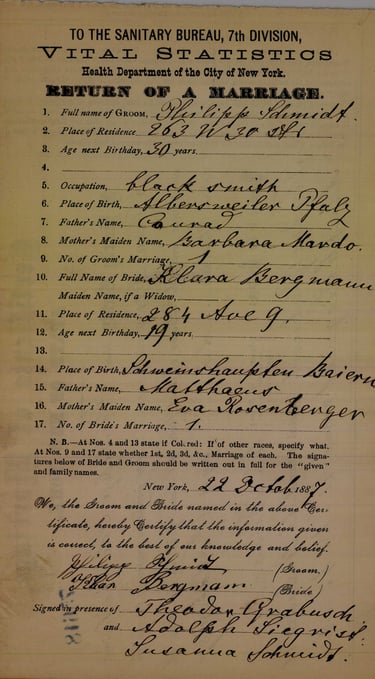
Klara Bergmann, born around 1868, in Schweinshaupten, Bavaria
Barbara Bergmann, born February 9, 1875, in Schweinshaupten, Bavaria
And here, the first mystery appears.
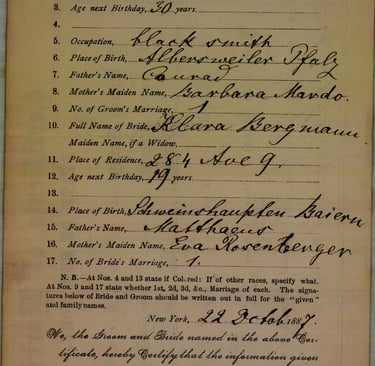
Records name different fathers for the girls—Matthaeus and Andrew. Whether this reflects multiple marriages, clerical error, or something more complicated, we may never fully know. But what remains certain is this: Eva was raising two daughters in Bavaria before her life changed completely.
A Crossing—and a Separation
In the 1880s, Eva made the decision that would shape generations.
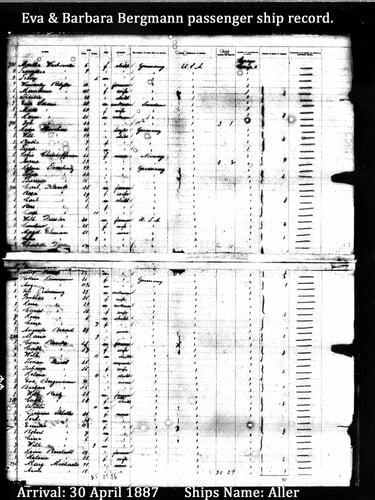
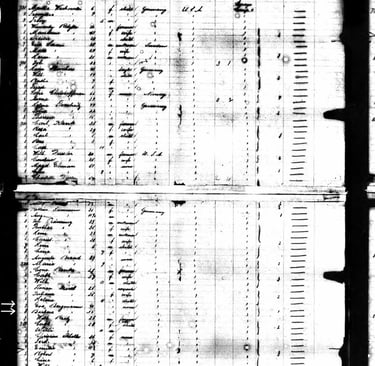
On April 30, 1887, she arrived in New York aboard the steamship Aller, bringing her youngest daughter Barbara with her. They stepped onto American soil at Castle Garden—Eva about 38 years old, Barbara just 12.
But Klara’s journey is far less clear.
Records suggest she may have arrived earlier, perhaps as a teenager. Yet no passenger list firmly places her beside her mother. By the time we find her again, she is already in New York, building a life of her own.
How a mother and daughter crossed an ocean separately—and found their way back to the same city—is one of the quiet mysteries this family still carries.
New Lives in New York
Both daughters would begin their American lives in the same place: among the German immigrant communities of New York.
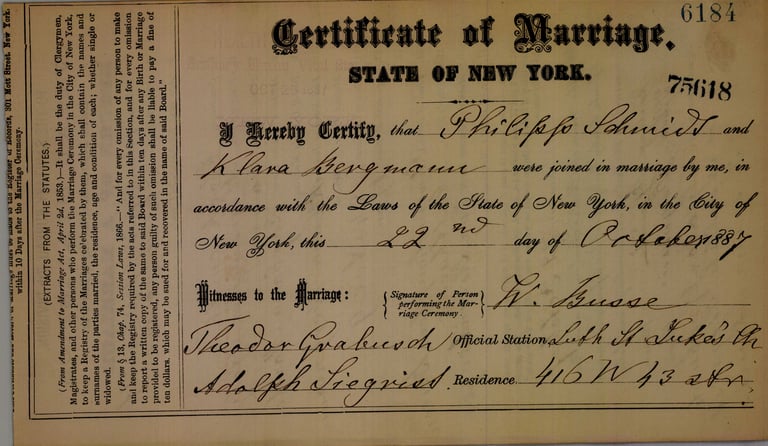
At St. Luke’s Lutheran Church, a hub for newly arrived families, both sisters were married.
Klara wed Johann “Philipp” Schmidt, a blacksmith, and built a large family, raising children who would later appear under both Schmidt and Smith.
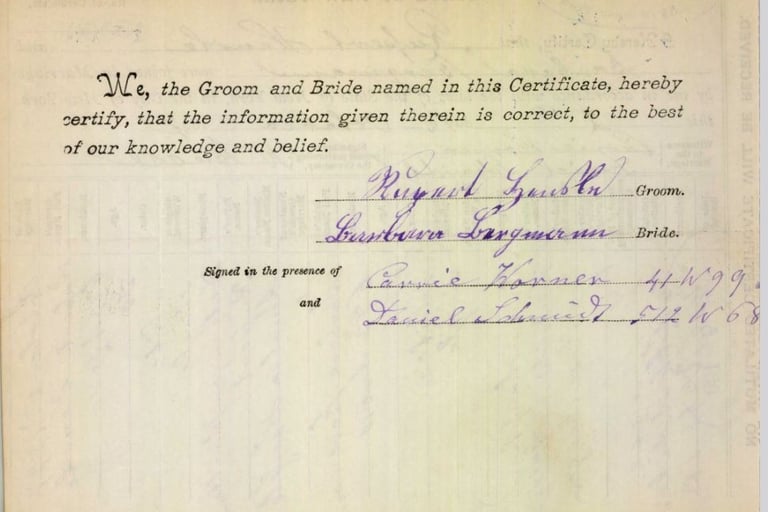
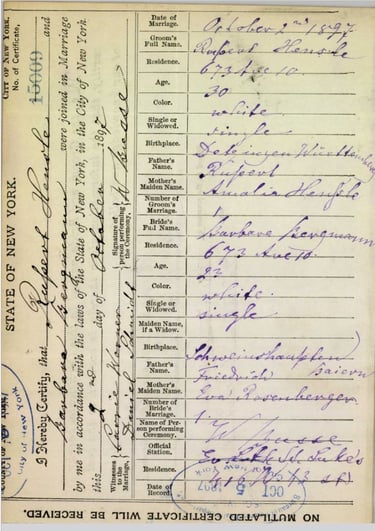
Barbara married Rupert Hensle, a butcher and slaughterhouse worker—hard, physical work that supported a growing household.
Their lives were not easy, but they were steady. Rooted in community, shaped by labor, and filled with the work of raising children in a new country.
A Second Beginning: The Hostetter Household
Not long after arriving in America, Eva began again.
In 1888, she married Frederick Hostetter, Sr., a Swiss-born immigrant and a man described in records as a plasterer, mason, and builder—someone who quite literally made his living creating foundations.
Together, they formed a blended family in Jersey City:
Frederick Hostetter, Jr. (1888–1943)
Helena Augusta “Lina” Hostetter (1890–1941)
Barbara, Eva’s daughter from her earlier marriage, was raised within this household as well—folded into the new family taking shape in America.
It was a home built not just of brick and plaster, but of second chances.
Losses That Came Too Close Together
For a time, life moved forward.
Then, in just a few short years, everything shifted.
In 1912, Barbara’s husband Rupert died, leaving her a widow with three young sons.
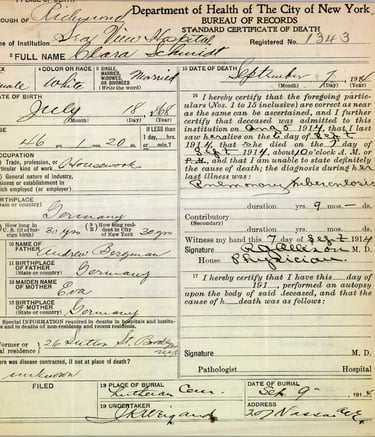
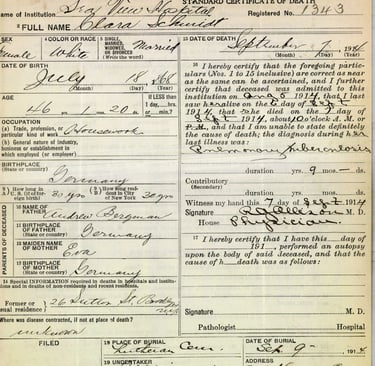
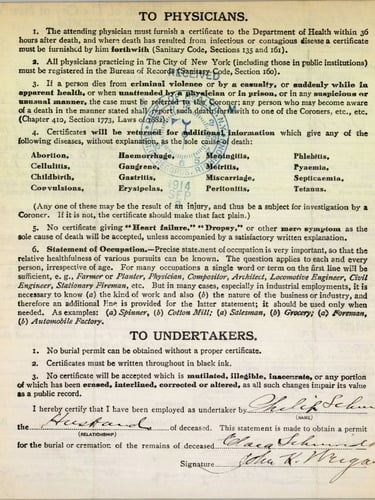
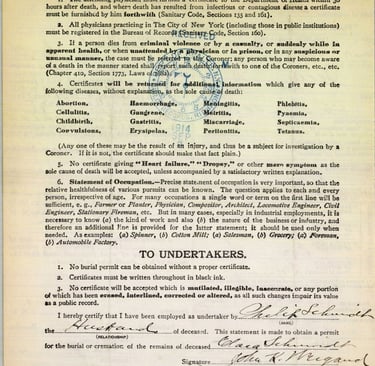
In September 1914, Klara passed away at just 46 years old.
And on November 5, 1914, Eva herself died in Jersey City.
Three losses. One family. Barely two years.
Whatever connections the sisters maintained, whatever stories they shared of the old country, whatever questions remained unspoken—much of it was lost in that brief, heavy span of time.
Those Who Carried the Story Forward
And yet, the story did not end there.
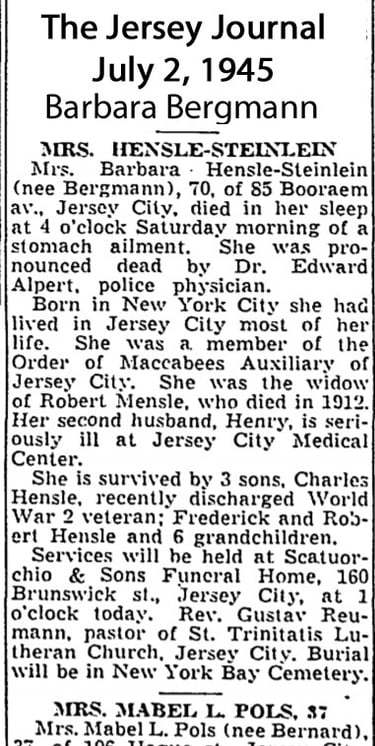
Barbara endured. She remarried, raised her sons, and lived until 1945, leaving behind children and grandchildren.
Klara’s children—bearing both Schmidt and Smith names—continued her line, even as parts of her story faded into uncertainty.
Fred Jr. grew into the line that would carry this family history forward for generations to come.
Lina, the youngest, remained closely tied to her mother—even in death, buried beside her in Jersey City.
And Frederick Hostetter Sr., the traveler who crossed oceans and built with his hands, remained the steady presence who helped anchor it all—until his death in 1930.
What We Still Don’t Know
Even now, the story resists being fully pinned down.
Were Klara and Barbara’s fathers the same man—or not?
How exactly did Klara make her way to America?
How much of their lives in Germany did they carry with them—and how much did they leave behind?
These are not gaps to be filled so much as reminders:
That family history is not just about answers.
It is about understanding the lives that came before us—even when they don’t fully explain themselves.
A Family, Remembered
From a small village in Bavaria—its name translating, somewhat bluntly, to “pig heads”—to the crowded streets of New York and the growing neighborhoods of Jersey City, this family built something lasting.
Not perfectly documented.
Not fully understood.
But enduring.
And in the end, that may be the truest record we have.
Details Behind the Story
Family recollections describe Eva as a short, sturdy woman with a strong Eastern European appearance—what one relative affectionately called a “babushka.” Some have speculated about possible Eastern European or Jewish roots, though this remains unconfirmed.
A family story recalls a photograph of Eva seated with her granddaughter Anna as a baby—a treasured image that has not yet been relocated.
Passenger records identify Eva and Barbara arriving aboard the steamship Aller, departing from Bremen and arriving in New York on April 30, 1887.
Records list different fathers for Klara and Barbara—Andrew Bergmann in some documents, Matthaeus Bergmann in others—raising the possibility of multiple marriages or record inconsistencies.
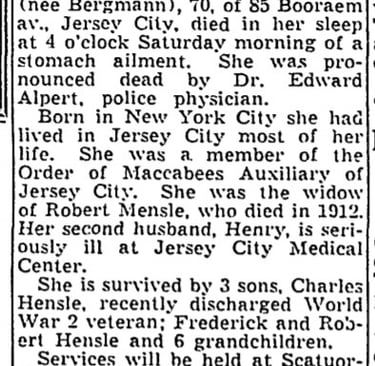
Barbara passed away at her home on Booream Avenue in Jersey City after a period of illness; her husband Henry was hospitalized at the time.
Barbara was also a member of the Order of the Maccabees, reflecting her connection to community and mutual aid societies common among immigrant families.
Family tradition holds that Frederick traveled the world five times before settling in Jersey City, though documentation is limited.
Eva and her daughter Lina are buried in Bay View – New York Bay Cemetery, near the Garfield Avenue entrance.
As with many immigrant families, census records for Eva vary in spelling, age, and origin—likely reflecting language barriers and enumerator interpretation.
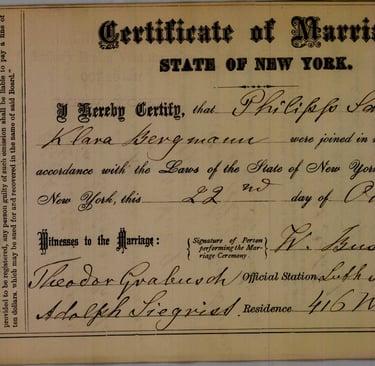
Both Klara and Barbara Bergmann were married at St. Luke’s Lutheran Church, located on West 46th Street in Manhattan, New York City, near the Times Square district. Barbara married Rupert Hensle on October 2, 1897, while Klara married Johann “Philipp” Schmidt on 22 Oct 1887. The church served a large German immigrant community in the late 19th century, making it a central place of connection for newly arrived families. The fact that both sisters were married at the same church suggests a shared community connection, even if their earlier journeys to America remain unclear.