
Because every life deserves to be remembered.
Cemeteries
Cemeteries are among the most valuable resources in genealogy.
They provide names, dates, relationships, and sometimes even glimpses into beliefs, occupations, or family connections. For researchers, they are often the place where questions begin to find answers.
But cemeteries are more than records.
They are places where lives came to rest.
Where stories pause—but do not end.
And for many, they are places where something deeper can be felt.
This page is guided by a simple belief:
Every person deserves to be remembered.
Not only the celebrated.
Not only the well-documented.
But also the forgotten, the complicated, the misunderstood.
Cemeteries hold them all.
When we walk among these stones, we are stepping into a shared human story—one that includes both the light and the shadow.
And in remembering them, we take part in something quietly meaningful.
One such story, shaped across generations of war, can be read here.


ACemeteries can reveal:
Full names and dates
Family groupings
Maiden names
Military service
Religious symbols
Clues to migration and community
Even a single headstone can unlock an entirely new branch of research.
But sometimes… it offers something else.


A Different Way to Visit
A gentle, holistic approach
There is no one right way to visit a cemetery.
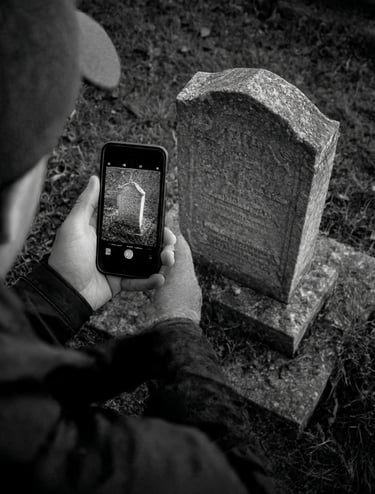
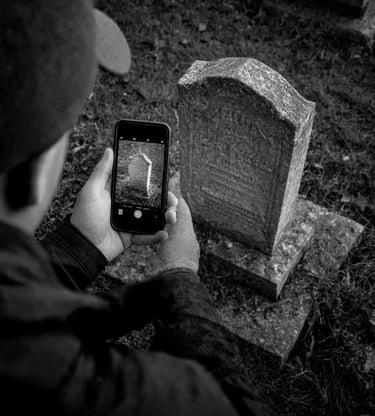
Some come with notebooks and cameras.
Others come with quiet reflection.
You are welcome to do both.
For those who feel open to it, a cemetery visit can also be a moment of connection—a chance to slow down, to observe, and to simply be present with those who came before.
A Gentle Grounding Before You Enter
Before you step into a cemetery—especially one long forgotten or overgrown—take just a moment to arrive.
Pause at the entrance, or even at your car.
Take a slow breath in… and let it out.
Look around.
Notice the quiet, the trees, the light, the way the place feels.
You don’t need to name anything. Just notice.
If it feels right, you might set a simple intention:
“I come with respect. I come to remember. I come to learn.”
Or simply:
“Let me see what I am meant to see today.”
There is no right or wrong way to do this.
Some visits will be practical—focused on names, dates, and photographs.
Others may feel more personal, in ways you didn’t expect.
Both have their place.
When you’re ready, step forward.
During Your Visit
Move slowly.
Notice what draws your attention—symbols, names, groupings of stones. If permitted, you may choose to gently touch a headstone… or simply rest your hand nearby. Some visitors leave small offerings such as flowers, coins, or stones, in keeping with cultural or personal traditions.
One of the simplest and most meaningful acts is this:
Say their name.
Even if no one else remembers… you do, in that moment.
For unmarked or neglected graves, your presence alone matters. Your being there says: You are seen. You are remembered.
Some also choose to:
Share a story aloud
Play music meaningful to the family
Place flowers
Clean a stone with care and respect
After Your Visit
Genealogy does not end at the cemetery gate.
Afterward, you may wish to:
Upload photos and notes to your family tree
Record what you observed
Reflect on what stood out
Some find it meaningful to journal.
A simple prompt might be:
“This life suggests strength in…”
“What part of their story feels familiar to me?”
Others write letters—to ancestors known or unknown.
There is no right way. Only your way.
If You Cannot Visit in Person
Not everyone can travel to a cemetery—and that’s okay.
Online resources like www.Find a Grave.com and www.BillionGraves.com allow you to explore burial sites from anywhere.
You might also create a small space at home:
A photograph
A name written on paper
A candle or meaningful object
What matters is not the location—but the intention.


Did You Know?
They say cemetery gates are locked at night to keep the residents from wandering…
…but according to a 1937 newspaper, the real concern wasn’t the dearly departed—
it was the dearly devoted.
In 1937, officials in Charleston, West Virginia closed the gates to Spring Hill Cemetery after nightfall—not out of fear of the dead, but to preserve respect among the living, whose visits had grown a little too spirited.
Newspaper descriptions included “midnight petting parties,” night parking, and a full-fledged lovers’ lane. Councilman Gates himself remarked,
“The members of this body know, as do I, of the things that go on up there. Some of them would curl your hair.”
Personally, I would very much like to know where the good Councilman Gates acquired such… intimate knowledge.
Source: The Charleston Daily Mail, June 8, 1937, page 1 — “Petting Parties Banned at Cemetery After Nightfall.”
Cultural Traditions of Remembrance
Many cultures have long honored their ancestors through acts of remembrance.
From Día de los Muertos altars, to African American homegoing traditions, to quiet visits with flowers or prayer—these practices reflect a shared human desire:
To remember.
To honor.
To stay connected.
You are encouraged to explore traditions that feel respectful and meaningful to you.


Relocated Cemeteries
Not all resting places remain where they were first laid.
Over time, some cemeteries have been relocated—moved due to development, roadways, environmental changes, or the quiet passing of time. In some cases, the names were carried forward. In others… they were not.
This has always felt important to record.
Because when a cemetery is moved, something more than land is changed.
Stories can become harder to find.
Connections can fade.
This site includes a growing record of relocated cemeteries—preserving known names, locations, reasons for relocation, and, when possible, where those individuals were reinterred.
Explore the Relocated Cemeteries Archive → (link to new page)
Because even when the ground changes…
the people should not be forgotten.