The Life Story of Klara Bergmann Schmidt
Klara Bergmann Schmidt (1868–1914)
Early Life in Bavaria
What is certain is that Klara’s life would carry her far from Bavaria.
Immigration to America (1883)
According to the 1900 census, Klara immigrated to the United States in 1883. If that date is correct, she would have been only fifteen years old when she arrived in America. No passenger list has yet been found to explain how she made the crossing, who accompanied her, or whether she traveled entirely alone. That unanswered question lingers over her story like fog rolling through New York Harbor.
If she did arrive alone, she would not have been the only young immigrant girl stepping nervously into Castle Garden—the immigration station that processed newcomers before Ellis Island opened in 1892. But knowing others did it does not make the journey feel any less extraordinary. Somewhere between the villages of Bavaria and the crowded streets of Manhattan, Klara’s old life disappeared behind her.
The New York she entered was loud, crowded, restless, and growing faster than almost any city in the world. Horses pulled wagons through streets paved in dirt and cobblestone. Elevated trains thundered overhead. Coal smoke drifted between brick buildings and tenement windows hung heavy with laundry lines. Street vendors shouted in dozens of languages while church bells echoed through neighborhoods packed tightly with immigrants searching for work and stability.
Yet for German immigrants like Klara, parts of New York may have felt strangely familiar.
Life in New York’s German‑American Communities
By the 1880s, New York City had a massive German-speaking population. German bakeries, butcher shops, beer halls, newspapers, churches, and social clubs filled entire neighborhoods. Lutheran congregations helped newly arrived immigrants build communities in a city that could otherwise feel overwhelming. It was within this German-American world that Klara’s adult life slowly took shape.
Marriage to Johann “Philipp” Schmidt
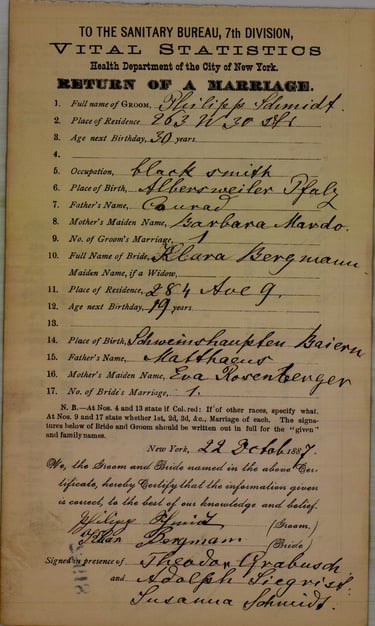
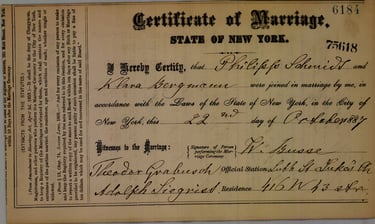
On October 22, 1887, at St. Luke’s Lutheran Church on Manhattan’s West Side, Klara married Johann “Philipp” Schmidt, a blacksmith. Their marriage record places Klara at 284 Avenue G and Philipp at 963 West 30th Street—addresses that belonged to a New York now largely vanished beneath redevelopment, bridges, industry, and time.
Philipp’s trade placed him in the heart of the working city. A blacksmith in late nineteenth-century New York lived among noise, heat, sweat, and iron. Horses still powered transportation, delivery wagons, drays, and street commerce. Blacksmiths shoed horses, repaired wagon hardware, shaped metal fittings, and kept the machinery of the city moving. Sparks flew from the forge while hammer blows rang against anvils from workshops tucked into crowded industrial streets.
It was hard work, but it was respected work.
Raising a Family in a Changing City
And while Philipp labored at the forge, Klara built a home and raised a growing family amid the constant motion of immigrant New York.
Their first child, Philip Jr., arrived in October 1888. William followed in 1890, then Carl in 1893. Tragically, little Carl died in childhood, a sorrow shared by countless immigrant families living in crowded cities where illness spread quickly and medical care remained uncertain. Daughter Barbara Elizabeth—later known as Elise or Elsie—was born in 1896. Her middle name, Barbara, was likely chosen in honor of Klara’s sister, preserving a thread of family connection stretching back across the Atlantic. Edward followed in 1899, and Otto Conrad in 1901.
The family’s surname shifted over time between Schmidt and Smith, reflecting a common pattern among immigrant families trying to navigate American life. Names softened, shortened, or changed entirely as generations adapted to English-speaking neighborhoods, schools, workplaces, and official records.
The Schmidts lived through an era when New York itself was transforming around them. During Klara’s lifetime, gas lamps gave way to electricity. Horse-drawn traffic slowly began sharing the streets with electric trolleys and early automobiles. Brooklyn Bridge had opened only a few years before her arrival, symbolizing a modern city rushing toward the twentieth century.
Homes in Manhattan and Brooklyn
Census records show the family living in Manhattan in 1900 on 49th Street before later appearing in Brooklyn by 1910 at 26 Sutton Street in Kings County. Their move reflected the path many immigrant families took as they searched for affordable housing and greater stability outside Manhattan’s increasingly crowded neighborhoods.
New York in Klara’s Lifetime
Somewhere beyond the apartment windows, New York never stopped moving. Ferry whistles drifted across the harbor. Factory bells marked the hours. Children played in narrow streets beneath hanging laundry while peddlers pushed carts filled with vegetables, bread, fabric, and household goods. German hymns floated from church services while ragtime music and vaudeville sounds began creeping into the city’s entertainment halls by the early 1900s.
Klara spent more than thirty years building a life inside that restless city.
Unanswered Questions
Yet despite all the records, questions remain.
We still do not know exactly how she arrived in America, whether she traveled alone, or how much contact she maintained with her mother Eva and sister Barbara after settling in New York. In some ways, Klara seems to appear suddenly in Manhattan already carrying pieces of a life whose earlier chapters have faded from view.
Death and Legacy
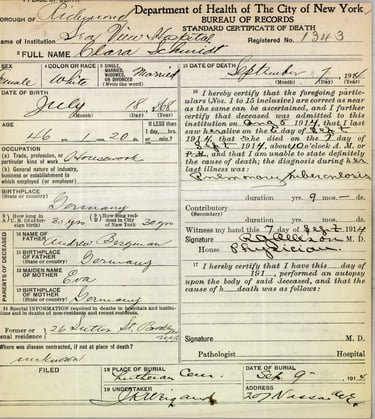
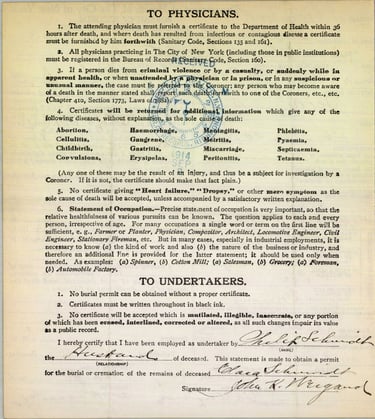
Klara died on September 7, 1914, in Richmond County (Staten Island) at age forty-six and was buried two days later at Lutheran Cemetery.
Her life stretched from a small Bavarian village to the industrial streets of old New York. Though some chapters remain missing, her story survives in the records she left, the children she raised, and the descendants who continue searching for her across generations.
--> Read more about the Bergmann Sisters Story