Tennessee Valley Authority and Relocated Cemeteries: How Dams Reshaped Burial Grounds Across America
TENNESSEE
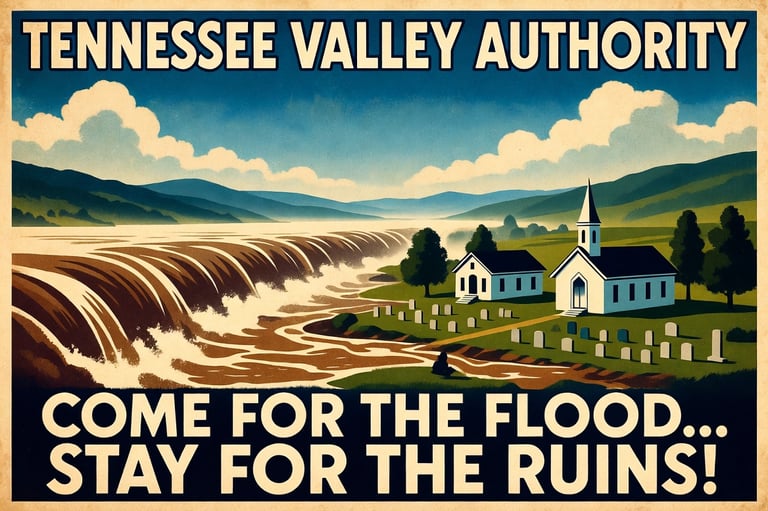
TENNESSEE VALLEY AUTHORITY
On November 29, 1981, The Dallas Morning News (Dallas, Texas) reported that a pre–Civil War slave cemetery would be relocated to make way for the construction of the Richland-Chambers Reservoir, southeast of Corsicana, Texas.
But what is the Tennessee Valley Authority, you may ask?
Despite its name, the Tennessee Valley Authority (TVA) was responsible for transforming—and flooding—the river valleys across seven states: Tennessee, Kentucky, Georgia, Mississippi, North Carolina, and Virginia. Created in 1933 during the Great Depression as part of Franklin D. Roosevelt’s New Deal, its mission was ambitious: build dams for flood control, generate hydroelectric power, and improve navigation and agriculture.
And as noble as those goals may have been, the cost was deeply personal.
In the process, entire ways of life were disrupted—towns, farms, businesses, schools, and churches. The TVA paid for land and structures—but not for the roots people had put down. Checks were issued, whether families were ready to leave or not, and new ground was found. But communities were not simply relocated—they were scattered.
Goodbyes were said.
To the teacher at the school.
To the minister at the church.
To the shopkeeper who knew your name.
To neighbors who had always been just across the way.
And sometimes even within families, paths split—some drawn toward cities and opportunity, others holding fast to what had always been home.
And then, just when it might have seemed that everything had already been asked of them…
The TVA reached into the quietest, most sacred part of life.
Your family burying ground.
Removed.
Relocated.
Replaced.
Entire cemeteries—sometimes small family plots, sometimes large community burial grounds—were moved to higher ground. This included rural, unrecorded burial grounds, graves marked only with fieldstones, and sites known only through memory and tradition.
Because for many families, these were not just burial sites. They were final resting places. Places where the words “Rest in Peace” were not simply spoken—they were believed. Promised.
And now, even that promise felt uncertain.
The TVA developed what was, for the time, a careful and systematic process.
Survey crews first moved through communities, identifying cemeteries and asking local residents for guidance. Even so, some graves—especially unmarked ones—were missed.
Then came the disinterment. Crews returned to carefully exhume the dead. Coffins, if present, were removed; otherwise, remains were gathered as respectfully as possible. Occasionally, personal items were recovered.
Finally, the remains were reinterred—either in newly created cemeteries or in existing ones where space allowed.
It is estimated that more than 10,000 graves were moved.
And in that quiet, difficult work, there was still an effort—whenever possible—to keep families together, even recreating original layouts. Headstones were moved when they could be. When they could not, new markers were placed.
Even when handled with care, the emotional weight was immense.
Families—often already in the midst of leaving their homes—were asked to move their dead as well, not knowing if these new resting places would ever feel the same… or even remain accessible in the years ahead.
Sometimes, despite all efforts, the process faltered. Documentation was inconsistent. Some names were recorded clearly; others were lost to time. Some graves were never found. Others were never identified.
A quiet truth that lingers not just in TVA history—but in cemeteries everywhere.
For family historians, the effects are still felt today.
Burial locations may not match original records. Graves may have been moved miles away, or renamed under new cemetery designations. What was once known as a small family plot may now appear under an entirely different name—its story reshaped along with the land itself.
Looking for Your Tennessee Valley Ancestors?
You may find helpful records in:
TVA cemetery removal records
Reservoir project reports
County historical societies in affected areas
Local relocation records
In reshaping the rivers of the Tennessee Valley, the TVA also reshaped the resting places of thousands.
Some were carefully carried to higher ground.
Others were quietly left beneath the waters.
And yet—all remain part of the story.
Not lost…
Just waiting to be remembered.
The Tennessee Valley Authority was not alone.
Across the country, agencies and power companies reshaped rivers and valleys in the name of progress—each leaving behind its own map of moved homes, scattered communities, and cemeteries carried to higher ground.
First, The Big One
The Tennessee Valley Authority (TVA)
Multi-state transformation—dams, reservoirs, entire valleys flooded.
Federal Agencies Included
🌊 U.S. Army Corps of Engineers
Perhaps the closest comparison to the TVA—though it reports through the Department of Defense. During this peacetime work, the Army built dams, levees, and reservoirs nationwide, often through Congress-approved initiatives.
They were responsible for:
Flood control projects
Navigation systems
Large reservoirs (many requiring cemetery relocations)
They might best be described as “the federal government’s engineering and construction arm.”
At times, the TVA and the Corps worked together—coordinating on river systems, sharing data, and aligning projects.
But each remained independent of the other.
🌊 Bureau of Reclamation
Focused on the Western United States, building massive irrigation and dam systems such as the Hoover Dam and Grand Coulee Dam.
Entire towns—and burial grounds—were also displaced in these western reservoir projects.
State and Regional “Authorities”
Individual states and companies created their own authorities to produce hydroelectric power and manage waterways.
Alabama Power Company
Built dams forming Lake Martin in the 1920s, relocating multiple cemeteries before valleys were flooded.🔌 Duke Power
Created Lake Norman, North Carolina (1959–1963), purchasing land, relocating cemeteries, and reshaping entire communities.South Carolina Public Service Authority
Built the Stee-Cooper project (1930s–40s), flooding large areas and affecting more than 150 cemeteries.Lower Colorado River Authority
Developed reservoirs across Texas with similar impacts: relocations, lost cemeteries, and community disruption.And Beyond These, smaller but similar authorities existed across the country. You’ll see this pattern repeated again and again: River authorities (varying by state), Flood control districts, Hydroelectric companies, and Municipal water authorities
Even when the word “Authority” was not part of the name, the function was often the same.
And this didn’t happen once.
It happened everywhere.
And it was not confined to any one community—
it followed the rivers, and it touched all who lived in their path.