The wife of our Patrick "The Pioneer" McGill. And if he was a Pioneer, she was equally a Pioneer Woman.
Anna Marie Baird
1764-1837
Birth 1764 • Northumberland County PA
Death 27 APRIL 1837 • Saegertown, Crawford County, Pennsylvania
Daughter of Tabitha Elizabeth Jones and William C Baird.
Spouse - Patrick McGill
Anna Marie Baird McGill (1764–1837) was a woman of uncommon courage, determination, and faith. Born in Northumberland County, Pennsylvania, the daughter of William C. Baird and Tabitha Elizabeth Jones, she came from respected Scotch-Irish stock and was described by later generations as "well educated for the times; amiable, motherly, strong and resolute as became the dames of those olden days."
History remembers her husband as Patrick "The Pioneer" McGill, but those who knew their story understood that his accomplishments were also hers. If Patrick was a pioneer, Anna Marie was every bit the Pioneer Woman.
A Mother on Horseback
In the autumn of 1795, Patrick and Anna Marie left the settled Susquehanna country and began the difficult journey westward toward the wilderness of Crawford County, Pennsylvania.
The trip was no ordinary migration.
Their son John McGill had been born on October 19, 1795. Barely six weeks later, the family was crossing the Allegheny Mountains into an untamed frontier.
While Patrick guided a wagon drawn by oxen, Anna Marie rode at the head of the little procession on horseback. In her arms she carried her six-week-old infant son, taking what one family historian later called his "first lesson in overland travel."
As mountain streams and wilderness obstacles blocked their path, Anna Marie repeatedly proved herself equal to every challenge.
Not a Woman to Borrow Trouble
The 1910 history of the McGill family by Augustus McGill offered one of the finest descriptions of her character:
"Anna Marie was not a woman to borrow trouble, but when confronted with it she was always ready to meet it."
Those words seem to summarize her life perfectly.
The author went on to describe her as a woman who possessed both gentleness and fearlessness. Mounted upon her horse, she rode ahead of the wagon whenever dangerous streams had to be crossed. It was Anna Marie who located the safest passage through rushing water, allowing the wagon, oxen, and family to follow safely behind.
The historian's admiration was unmistakable:
"On her good steed she would have charged a battalion in defense of her loved ones... this gentle Amazon of the forest and the ford."
Such language was rarely applied to women in nineteenth-century histories, making the tribute all the more remarkable.
The Night of the Wolves
One episode from the journey became family legend.
While descending the western slopes of the Alleghenies, the McGills sought shelter near a mountain spring in a crude cabin used by travelers. As darkness fell, they found themselves surrounded by packs of timber wolves.
Not the small coyotes familiar to later generations, but the great northern timber wolves that once roamed Pennsylvania's forests.
Patrick prepared defenses around their camp, but Anna Marie was no passive observer.
Throughout the night she stood watch alongside him while the wolves circled ever closer. When the pack attempted to rush the camp, Patrick fired his rifle while Anna Marie joined the defense by clanging pots, kettles, and cooking utensils in a tremendous uproar.
Later, when the wolves regrouped for another attack, she seized the dinner horn and sounded a blast so powerful that it echoed from hilltop to hilltop.
The family historian delighted in the image:
"Anna played the horn as if she was sounding the hosannas of the saints."
As dawn broke over the mountains, the wolves finally retreated and the little family continued safely toward their destination.
It was a victory won not only by Patrick's rifle, but by Anna Marie's courage and determination.
Building a New Life
After surviving the journey west, Anna Marie helped establish a home in the wilderness of what would become Crawford County.
Life on the frontier demanded constant labor and sacrifice. Together, she and Patrick raised five children:
John McGill
William Perry McGill (our direct ancestor)
Nancy McGill
Charles Dillon McGill
Maria McGill
While Patrick cleared land and built homes, Anna Marie managed the equally demanding work of raising a family in a region where roads, schools, churches, and communities were still being formed.
The success of the McGill family in western Pennsylvania rested as much upon her strength and perseverance as upon Patrick's.
A Faithful Companion
Anna Marie and Patrick spent decades together building their lives in the Pennsylvania wilderness.
When she died on April 27, 1837, at Saegertown, Crawford County, Pennsylvania, Augustus McGill later remembered her with words that speak volumes:
"Anna Maria, his faithful coadjutor, companion and comforter through all the strenuous years of life's battle for the right."
It was not merely the tribute of a husband or descendant. It was recognition that she had shared every hardship, every risk, and every triumph of the pioneer experience.
Her Final Rest
Anna Marie was laid to rest beside Patrick in the old cemetery near the community they helped establish.
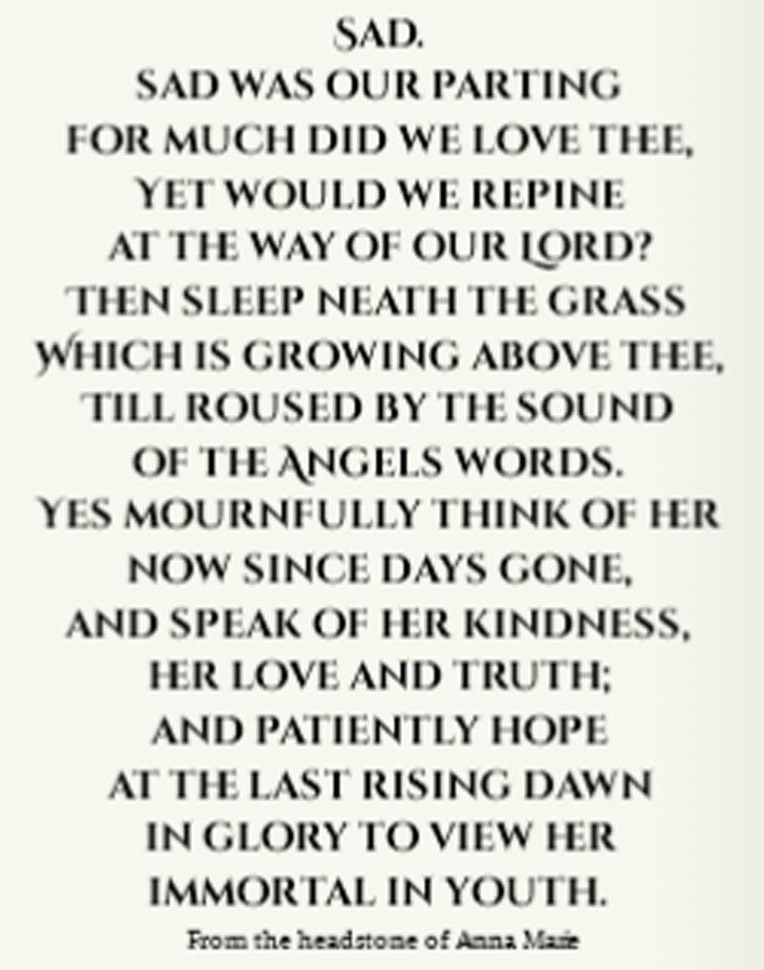
Her gravestone bears a touching verse:
Sad was our parting,
For much did we love thee;
Yet would we repine
At the way of our Lord?
The epitaph speaks of grief, faith, and the hope of reunion beyond this life—a fitting memorial for a woman whose life was marked by devotion to both family and faith.
Legacy of a Pioneer Woman
The story of Patrick McGill is often told as the tale of a pioneer.
Yet behind every mile traveled, every stream crossed, every wolf faced, and every cabin raised stood Anna Marie Baird McGill.
She rode into the Pennsylvania wilderness carrying an infant in her arms. She guided her family through danger. She helped establish a home on the frontier and raised the next generation that would carry the McGill name forward.
More than two centuries later, she remains exactly as Augustus described her: