A Juneteenth Journey Through Family, Freedom,
and 250 Years of American History
Our 2026 Pilgrimage... to Pennsylvania
Following the Flags Home
As America prepares to celebrate her 250th birthday in 2026, I found myself thinking about the people who carried our family through those two and a half centuries.
Some crossed oceans.
Some fought wars.
Some cleared forests and built homes from logs cut by their own hands.
Some preserved stories so future generations would know where they came from.
And some simply loved their families enough to keep going when life became difficult.
This is the story of a journey Thom and I took on Juneteenth, 2026, to remember them.
Not just the names and dates carved in stone.
But the lives they lived.
The sacrifices they made.
The Americans they became.
The family they left behind.
We had barely unpacked from a lengthy stay helping my mother while my sisters enjoyed a cruise when another family need called us northward. Our daughter, who lives with chronic health challenges, was having an especially difficult time, and so once again we loaded the van and headed for New Jersey.
Family has a way of doing that. It calls us when we are tired. It calls us when it is inconvenient. It calls us because that is what families do and have always done.
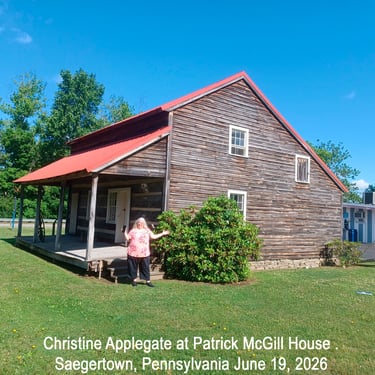
Once we knew she was on steadier ground, we continued on to northwestern Pennsylvania, where generations of our family are buried, to spend Juneteenth visiting the home of our Irish patriarch Patrick McGill, and walking among the graves of those whose lives had shaped our own.
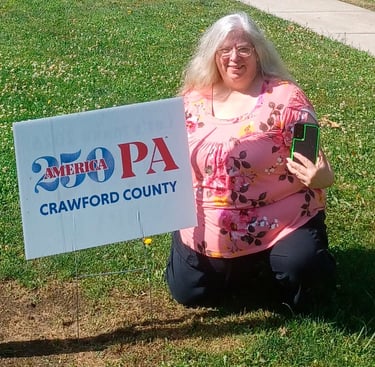
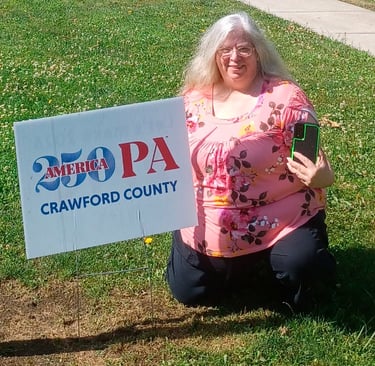
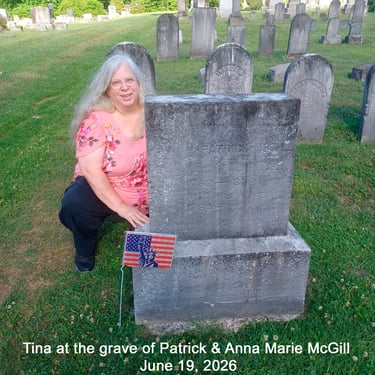
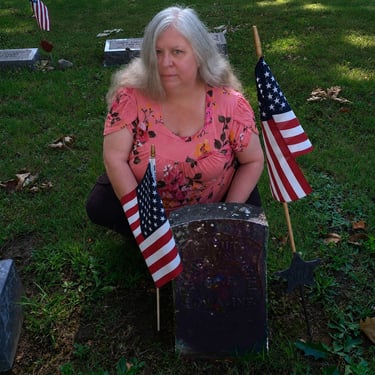
That's me, looking just a little giddy to be kneeling in the grass at the home of my ancestors. And if you're wondering why I'm holding my phone so awkwardly, it's because I'm Face-Timing with cousin Kerri in England, making sure she could be part of the moment, too.
Thirty-Six Years Earlier
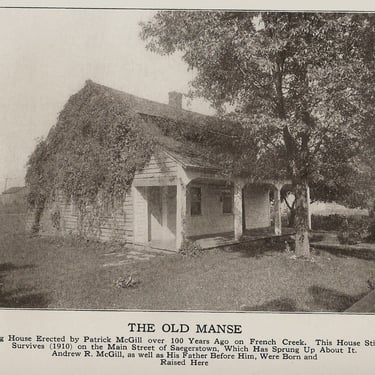
This was not our first trip to Saegertown. Back in 1990—or was it 1991?—we packed the kids into the station wagon and drove from our then home in Pottstown, Pa., to Saegertown, Pa., just to go to the Saegertown library, as I had heard they had a book by an Augustus McGill that told all about the family history of our ancestors the McGills titled: The McGills, Celts, Scots, Ulsterman and American Pioneers. This was long before the days of Google, before Ancestry, before online records. We were literally chasing a story down the highway.
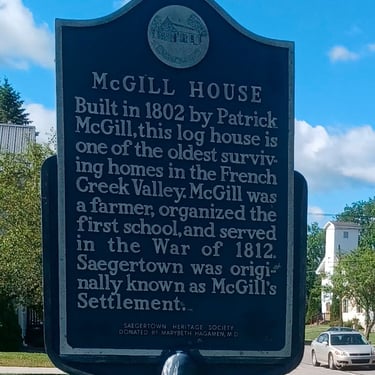
At the library we didn’t have a lot of time looking at the book, but we were allowed to photo-copy some pages. One page showed a picture of the house Patrick McGill had built. As we were driving out of town, I saw a house on the Main Street that reminded me of the one from the book. I told Thom to stop the car, so I could look. I don’t know what possessed me, but I walked up to that door (9 a.m. on a Saturday morning) and knocked. The lady who opened the door was in her jammies. I was so stunned to see what looked like the picture in the book, I bluntly asked, “Is this the Patrick McGill house?!”
She responded, “I don’t know, but you can read that brass plaque over there to see.”
Holy Moly. It was. I think I cried.
People often talk about Southern hospitality, but let me tell you about Pennsylvania graciousness.
Saturday morning, in her jammies, this woman invited us in to see the rough hewn walls cut and stacked by my 5th great grandfather himself, while her husband and children sat there watching cartoons. She explained that they were renters (she had no duty to let me in! How can anyone be so generous?!) and that there had, of course, been some improvements to the house, like bathrooms and a kitchen being added, siding outside. I laid my hands against the living room wall and it was like going back in time. It was almost like touching Patrick McGill himself.
Those moments rarely come around in life.
As I left, she gave me the name and address of the landlord, and I told her, if the opportunity ever arrived I would do whatever it took to buy the house.
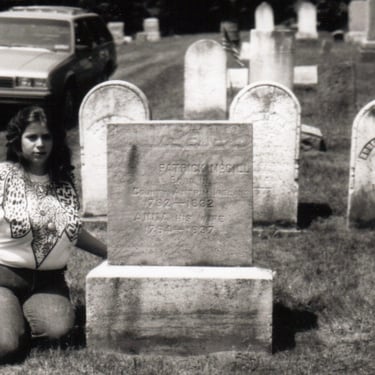
We completed our little trip by visiting the Saegertown cemetery where Patrick McGill and wife Anna Marie Baird are laid to rest. Quickly snapping as many photos as we could, appreciating that the kids who had behaved like little saints until now would eventually get worn out and cranky.
The Historian Who Saved Our Story
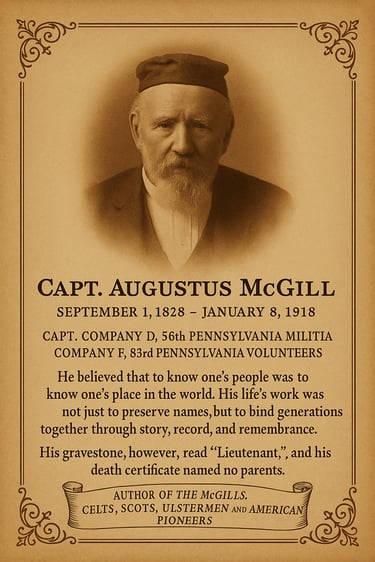
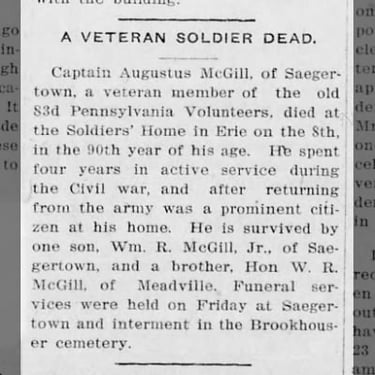
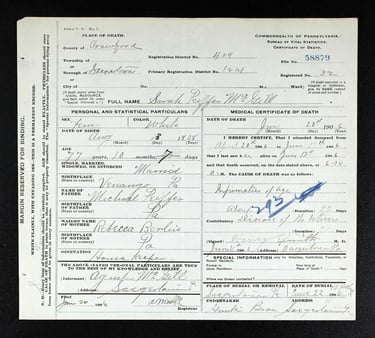
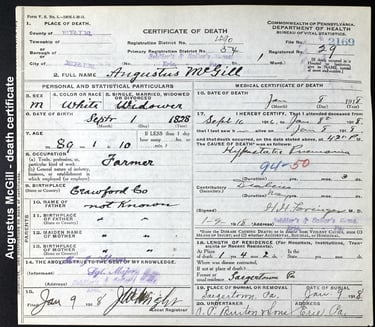
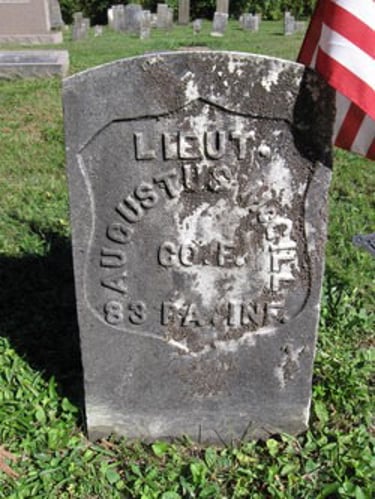
Our first visit that Juneteenth morning was Brookhouser Cemetery, only about a mile up the road from Saegertown Cemetery. It seemed fitting that on a day remembering the long road to freedom, we began by honoring Augustus McGill—a Civil War veteran and historian whose service, like that of so many of his McGill relatives and neighbors who fought for the Union, helped preserve the nation that made Juneteenth possible.
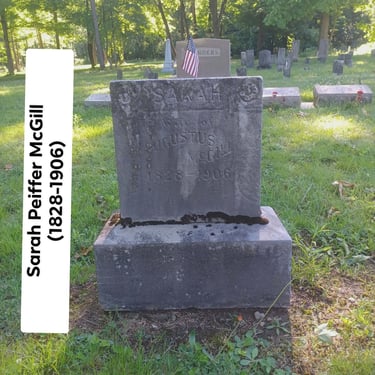
So Thom and I walked through the dew covered summer morning grass until we found his resting place, next to his wife Sarah.
I called cousin Kerri in England on ‘Face-time’ and she gently greeted him, “Hello Augustus.” I think she thanked him for everything he did for us. Thom found a video to play TAPS, and with hands over our hearts, we stood in honor. We placed a flag.
As we left the cemetery, I thanked Augustus for his service, his life, and lifes’ work, with a promise that we will do whatever we can to see that he is not forgotten.
Had Augustus McGill never picked up a pen, much of what we know today might have vanished forever.
Instead, he chose something else.
He chose preservation.
He gathered names.
He collected stories.
He recorded dates.
He connected generations.
He rescued memories from oblivion.
He gave descendants he would never meet a way to find their way home.
Patrick McGill's America
Then it was time to visit his grandfather Patrick McGill. A completely different type of cemetery, fortunately. This one we could drive through and look for section 3, where his plot and most of the McGill family plots were located.
And find him we did, exactly where I remembered him from thirty-six years earlier.
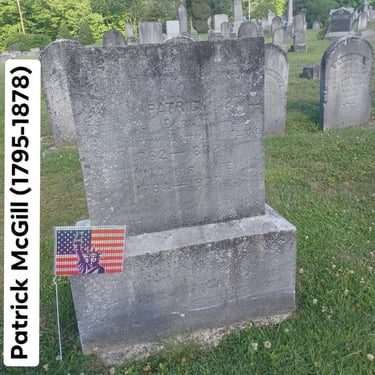
And I was back on the phone with Kerri. We looked at Patrick’s grave-marker. There was no flag here, so I placed one, not a traditional flag, but a flag with an overlay of a picture of Lady Liberty to represent that he was both an immigrant and a soldier in the War of 1812.
The engraving on Anna Maries side of the stone is no longer readable, but I recited it as I remembered, “Sad, sad was our parting, for much did we love thee; but who would repine at the will of our Lord? So sleep 'neath the grass which is growing above thee, till roused by the sound of the angel's horn.”
As I walked the rows, with Kerri watching on Face-time, Thom was carefully taking photos of all
the graves that said McGill, or I pointed out family with other surnames. (They can be viewed at Saegertown Cemeteries 2026)
When Patrick McGill arrived in America, the nation itself was still young.
He helped build it.
An immigrant.
A pioneer.
A husband and father.
A veteran of the War of 1812.
A man who looked at wilderness and imagined a future.
Standing at his grave more than two centuries later, it was impossible not to wonder what he would think of the nation his descendants now call home.