"When tragedy reshaped her family, Julia Anna Cochran became its quiet foundation."
Julia Anna Cochran (McGill)
(1799-1870)
Juliana Cochran McGill, aka Julia Anna Cochran McGill
born Dec. 30, 1799. Pennsylvania
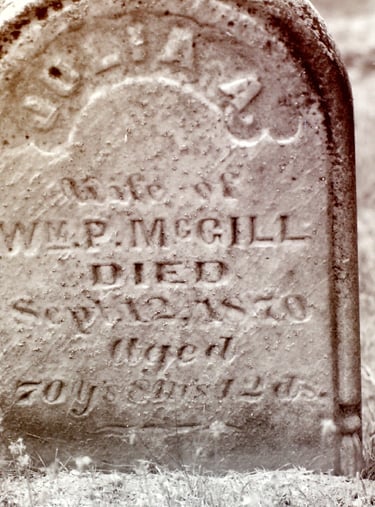
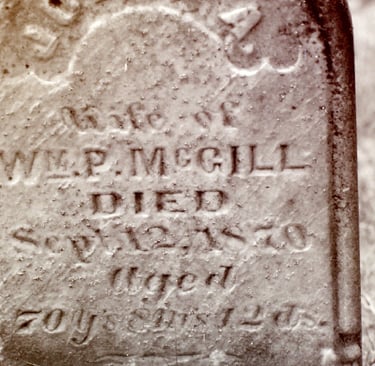
died Sept. 12, 1870. Crawford County, Pa
Parents: Margaret Johnston and an unidentified Mr. Cochran (given name unknown). Margaret subsequently married William Culbertson, who served as Juliana's stepfather. No records have been found explaining the circumstances under which the Cochran marriage ended.
Married: William Perry McGill Dec. 27, 1827 • Crawford County, Pennsylvania, USA
Buried at Saegertown Cemetery, Section 3
Children:
Jane Johnston McGill (1828-1828);
Anna Marie McGill (1829-1829)’;
Margaret Helen McGill (1830-1876);
Nancy Anna McGill (1832-1918);
William Johnston McGill (1834-1902);
John Patrick McGill (1836-1862);
Elizabeth Lucinda McGill (1838-1884);
Arthur Faulkner McGill (1841 - 1857);
Twin Boy (1843-1843);
Twin Girl (1843-1843).
Early Life
Julia Anna Cochran McGill was born on December 31, 1799, and brought both education and refinement to the McGill family. She came from a well-connected Pennsylvania family and maintained ties to relatives in Pennsylvania, Kentucky, and Tennessee. Those who knew her remembered her gentle nature, intelligence, and ability to form lasting relationships within both her family and community.
Marriage and Family
After marrying William Perry McGill, Julia helped establish their home in the growing settlements of northwestern Pennsylvania. Together they raised a family during a period when life demanded resilience, hard work, and sacrifice from every member of the household.
Caring for Her Husband
The greatest challenge of Julia's life came after her husband's devastating riding accident. The injury dramatically changed family life, transforming William from the strong and capable man she had relied upon into someone requiring constant care and supervision. During this difficult period, Julia became both caregiver and protector, balancing the needs of her husband and children while managing the emotional strain of the situation.
Family accounts describe long nights spent watching over William as his condition worsened. Her devotion during those final months left a lasting impression on those who witnessed it and became an enduring part of family memory.
Widowhood and Strength
Following William's death in 1847, Julia faced the challenge of rebuilding life for herself and her children. Drawing upon her strength, faith, and determination, she guided the family forward and maintained a home that remained a welcoming gathering place for relatives and future generations. Her perseverance through hardship, and her ability to provide stability during uncertain times, became one of her most remarkable legacies.
A Lasting Legacy
Julia Anna Cochran McGill died on September 12, 1870, in Crawford County, Pennsylvania. She is remembered not only as the wife of a respected pioneer farmer, but as a strong and capable woman whose courage helped sustain her family through one of its most difficult chapters.
Sources & Further Reading
Much of the information here is based on information
provided in the book written by Augustus McGill: The McGills -
(The Descendants of Patrick, The Pioneer, chapter XXVI)
1850, 1860, and 1870 United States Federal Census
Pennsylvania, Death Certificates, 1906-1944
U.S., Find A Grave Index, 1700s-Current
In the words of Augustus McGill, author of the book originally published in 1910:
The McGills, Celts, Scots, Ulsterman and American Pioneers; History, Heraldry and Tradition:
"Juliana, wife of William P. McGill, came to the place a young lady of education and refinement, well schooled in all the gentle accomplishments of her sex. She was very proud of her big husband and greatly admired his intellectual force and strong mental caliber, however crude they were. Her pleasing personality and gentle ways won the hearts of her new made relatives, and she was held in great esteem by all.
She came from a distinguished people, prominent in affairs. The Johnstons of Kentucky and Tennessee, notable men in the annals of war and statesmanship, were relatives of hers, and she was in frequent communication with these as well as other branches of the family. She was also connected with the Culbertsons and Colters of Pennsylvania, and her standing in social life was among the best.
When her husband's reason was dethroned, and the strong arm upon which she leaned for protection became a menace to her and her children, the ordeal was terrible. All other cares became of secondary importance, and she took her place by the side of her smitten husband and her gentle hand soothed his delirium as none other could. Sleepless vigils were hers, and during the hours of the night when the husband lay quiet on his couch, she would be found crouched down by the fireplace with a tallow dip by her side that the light might not be obtrusive, with open eyes, watching, watching, watching. The pathos of the scene cannot be written.
After the death of her husband, Juliana gathered up the shredded strands of her eventful life, and as might be expected from one of her blood and breeding, became the strong, self-reliant matron, and her home again became a place of cheerful resort for the oncoming generations."